
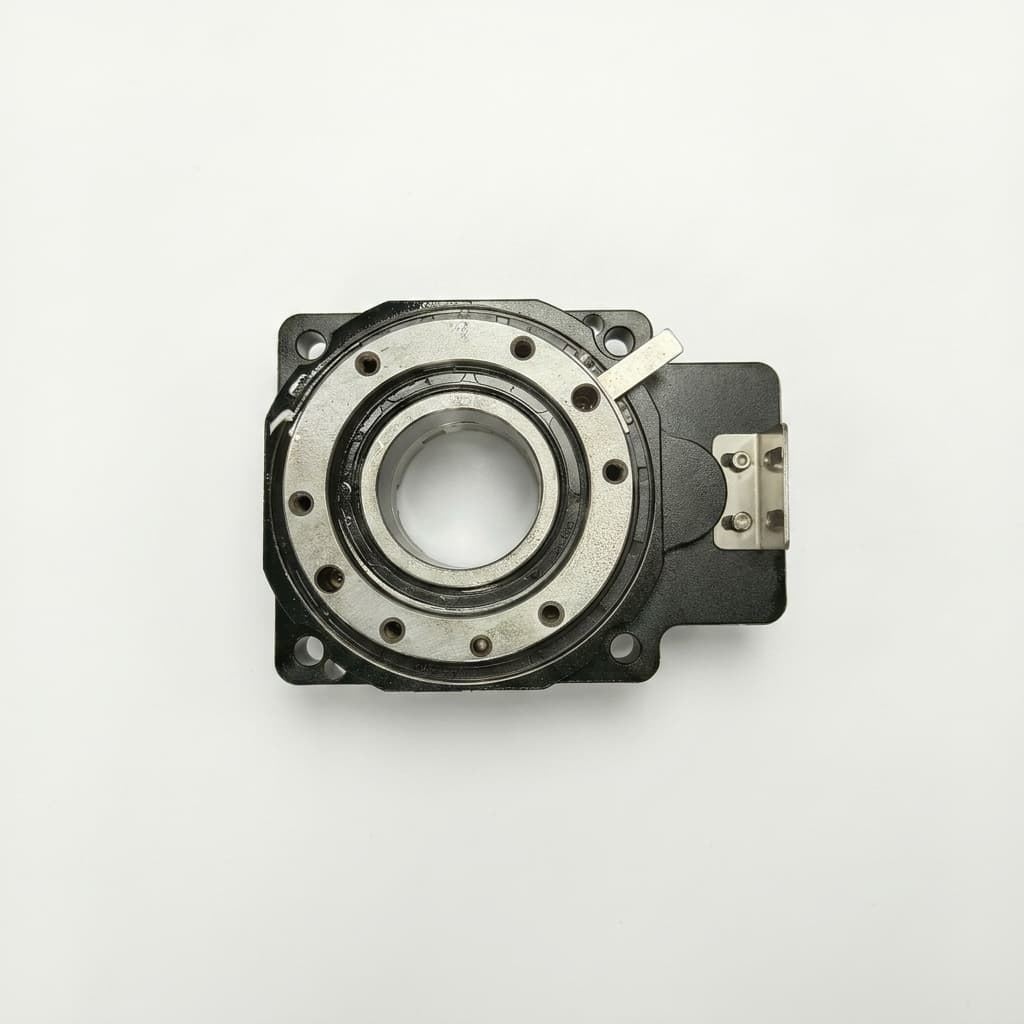
Arc-min vs. Arc-sec in Servo Rotary Actuators: A Backlash Procurement Guide
Compare arc-min vs. arc-sec backlash in servo rotary actuators, calculate radius error, and request the right precision spec before you issue the RFQ.
When procurement teams and engineers collaborate to source servo hollow rotary tables, one specification causes more budget overruns and lead-time delays than any other: gear backlash.
Should you source a standard indexing table rated for 3 arc-minutes or better, or do you need to pay a 30% to 50% premium for an ultra-high precision unit rated for 15 arc-seconds or better?
The core takeaway: Specifying "zero backlash" or arc-second precision when your manufacturing process only requires arc-minute accuracy is a guaranteed way to inflate your automation CAPEX. Conversely, under-specifying backlash on a long-radius dial table will result in unacceptable tolerance stack-ups and rejected parts. This guide provides a framework for buyers to source the exact precision their assembly line needs without overpaying.
Last Updated & Verified: July 18, 2026.
Key Conclusions for Procurement
- Precision Comes with a Cost Penalty: Upgrading from a 3 arc-min actuator to a 15 arc-sec actuator typically increases unit cost by 30% to 50% and can double procurement lead times due to specialized gear machining requirements.
- Radius Amplifies Error: A 1 arc-minute backlash translates to a 0.145 mm error at a 500 mm radius. The larger your dial table, the tighter your backlash spec must be.
- Repeatability vs. Accuracy: Do not confuse these two specs. A table with large backlash can still be highly repeatable if approaching the target from the same direction, which is often sufficient for standard indexing tasks.
- Application Dictates Spec: Micro-LED assembly and semiconductor wafer handling require arc-sec precision. General packaging, labeling, and dispensing can thrive on standard arc-min precision.
Visualizing Backlash Error Propagation
The primary reason engineers over-specify backlash is a misunderstanding of how the error translates to the outer edge of the rotating platform (the working radius).
Here is a visual representation of how a small angular backlash translates into a physical chordal error at the edge of the tooling plate.
Visual reference: As the working radius increases, even minute backlash angles result in substantial positioning deviations at the tooling stations.
The Math: Arc-min vs. Arc-sec
Before moving to the procurement guidelines, let us define the terms:
- 1 Degree = 60 Arc-minutes (arc-min)
- 1 Arc-minute = 60 Arc-seconds (arc-sec)
- Therefore, 1 Degree = 3,600 Arc-seconds
Most standard precision hollow rotary tables use planetary gears or standard cross-roller bearings that yield a backlash of 1 to 3 arc-minutes. High-precision tables use harmonic drives, zero-backlash cam rollers, or pre-loaded cross-roller assemblies to achieve < 15 arc-seconds.
Decision Matrix: When to Specify Which Precision
The following table breaks down the typical boundaries of when a buyer should source standard versus high-precision rotary actuators.
| Application Type | Typical Required Backlash | Component Cost Impact | Lead Time Impact | Example Use Cases |
|---|---|---|---|---|
| Heavy-duty Indexing | 3 arc-min or better | Baseline (1x) | Standard (2-4 Weeks) | Packaging lines, bottling, heavy welding stations, simple conveyor routing |
| General Assembly | 1 arc-min or better | +15% to 20% | Standard (2-4 Weeks) | Electronics assembly, light pick-and-place, CNC part loading, dispensing |
| High-Precision | 30 arc-sec or better | +30% to 40% | Extended (4-6 Weeks) | Laser marking on small parts, high-speed vision inspection, battery cell winding |
| Ultra-Precision | 15 arc-sec or better | +50% or more | Custom (6-10 Weeks) | Semiconductor wafer handling, Micro-LED placement, optical lens alignment |
| Zero Backlash | Direct Drive (0) | +100% to 200% | Extended (6-8 Weeks) | Nanometer-level positioning, continuous ultra-smooth velocity profiling |
Note: Cost and lead-time ranges are RFQ-screening assumptions for 2025-2026 supplier conversations, not guaranteed market averages. Validate final pricing, test method, and delivery date with shortlisted suppliers. "Zero backlash" mechanically does not exist in geared systems; it requires switching to Direct Drive Rotary (DDR) motors, which drastically shifts the TCO profile.
Understanding Failure Risks and Applicability Boundaries
While precision is often viewed as a purely positive attribute, over-specifying a rotary actuator can introduce unexpected failure mechanisms.
The Risk of High-Precision Brittleness
Standard planetary gearboxes (typically rated for 1 to 3 arc-min) use large, robust gear teeth. If a jam occurs on the dial table, these gears can often absorb the shock load without shearing. Conversely, high-precision harmonic drives (rated for < 15 arc-sec) rely on a thin flexspline. An unexpected E-stop or a mechanical crash can cause "ratcheting"—where the teeth slip and permanently deform—instantly destroying a high-value actuator.
Applicability Boundaries
- When Arc-Min Excels: Use standard arc-min actuators when the process allows for a mechanical lock or shot-pin at the final position, or when the process involves compliant materials (e.g., fluid dispensing, packaging) that absorb minor positional deviations.
- When Arc-Sec is Mandatory: Arc-sec precision is non-negotiable when dealing with rigid, brittle materials at long radii, such as silicon wafer handling or optical lens alignment, where a tiny error results in a shattered component.
Supplier Communication Fields
When submitting your RFQ, do not just send a CAD model. Include these critical communication fields to get an accurate quote:
- Max Moment Load (N·m): To ensure the cross-roller bearing will survive.
- Emergency Stop (E-Stop) Frequency: To gauge the required shock tolerance.
- Duty Cycle (%): To determine thermal dissipation needs.
- Target Chordal Accuracy (mm): Let the supplier calculate the required angular backlash based on your working radius, rather than guessing the arc-min requirement yourself.
Comprehensive Procurement & Engineering Evaluation Matrix
To prevent over-specification, use this 7-point evaluation matrix when communicating with suppliers. This serves as your primary decision tool for RFQs (Request for Quotations).
| Evaluation Dimension | Description / Buyer Decision Point | Standard Precision (Arc-min) | High/Ultra Precision (Arc-sec) | Supplier Communication Field (RFQ) |
|---|---|---|---|---|
| 1. Application Boundary | The physical limit where the actuator performs work. | Dial table radius under 300 mm | Dial table radius over 500 mm | "Specify working radius (mm) and required chordal accuracy." |
| 2. Dynamic Reversal | How often the table changes direction. | Unidirectional indexing (stops only) | High-frequency bidirectional moves | "Is the motion profile strictly unidirectional or bidirectional?" |
| 3. Load Inertia Ratio | The ratio of the load's mass moment of inertia to the motor's rotor inertia. | Stable loads, under 10:1 ratio | Fluctuating loads, under 30:1 ratio | "Provide estimated load inertia (kg-m^2) for motor sizing." |
| 4. Structural Rigidity | Capability of the machine frame to absorb motion energy without flexing. | Standard extruded aluminum frames | Solid machined steel or granite bases | "Confirm frame material; high precision requires ultra-stiff bases." |
| 5. Failure Risk / Wear | Likelihood of gear wear or failure under shock loads. | High shock tolerance, slow gradual wear | Sensitive to shock (e.g., harmonic drive ratcheting) | "What is the expected emergency stop (E-stop) torque impact?" |
| 6. Maintenance Expectation | Factory floor capabilities for preventative maintenance. | "Lube for life", minimal maintenance | Strict lubrication schedules, temperature control | "Specify acceptable maintenance intervals (hours of operation)." |
| 7. Operating Environment | Ambient conditions around the actuator. | Typical factory floor, dust/debris tolerant | Cleanroom (ISO Class 5 or better), temperature-controlled | "What is the IP rating requirement and operating temperature range?" |
Procurement & Engineering Checklist: Sourcing Rotary Actuators
Do not issue a Purchase Order for a precision rotary table until you have aligned with your engineering team on the following checklist. This minimizes the risk of over-specifying or buying a unit that will fail under production loads.
- Verify the Working Radius: Have engineering calculate the maximum radius where the actual work (e.g., dispensing, assembly) happens. Apply the formula E = R x tan(backlash angle).
- Confirm Unidirectional vs. Bidirectional Moves: If the table only ever rotates in one direction (e.g., a standard 4-stop indexer), backlash is naturally mitigated by load inertia and friction. You can likely buy a cheaper 3 arc-min table.
- Check the Load Inertia Ratio: Backlash is amplified if the load inertia is mismatched to the motor. Ensure the supplier provides an inertia matching calculation before quoting.
- Request the Test Methodology: Ask the supplier how they measure backlash. Is the motor shaft locked while measuring? Is it measured at the platform edge or internally?
- Evaluate the Bearing Capacity: High precision is useless if the main bearing cannot handle the axial or moment load. Ensure the cross-roller bearing is rated for at least 1.5x your expected dynamic moment load.
Total Cost of Ownership (TCO): The Hidden Price of Precision
Focusing solely on the purchase price of a high-precision actuator ignores the cascading costs it brings to the rest of the machine design. When procurement teams force engineers to use arc-sec actuators where arc-min would suffice, or conversely, when engineering blindly specifies high precision without a budget review, the Total Cost of Ownership (TCO) increases across four dimensions:
1. Structural Rigidity and Frame Costs
A 15 arc-sec rotary table will transmit extremely sharp acceleration and deceleration profiles. To actually benefit from this precision, the machine frame must be exceptionally rigid. If the frame flexes even slightly during motion, the precision gained at the actuator is lost at the tooling level. This forces the procurement of thicker steel frames, heavier vibration-damping leveling feet, and precision-machined mounting plates, driving up the overall bill of materials (BOM) cost by thousands of dollars.
2. Servo Motor Sizing and Energy Consumption
High-precision gearboxes often have higher internal friction due to pre-loaded bearings and tighter gear meshes. This means the servo motor must overcome higher breakaway torque just to start moving. Consequently, engineers must specify larger, more expensive servo motors and drives. Over a 5-year lifecycle, the increased electrical consumption of a larger servo system adds significant operational expenditure (OPEX).
3. Maintenance and Lubrication Intervals
Standard 3 arc-min planetary or cam-roller tables are incredibly robust and often "lubricated for life." High-precision harmonic drives or zero-backlash pre-loaded systems are much more sensitive to contamination and thermal expansion. They require strict temperature control and more frequent maintenance intervals. If a crash occurs (e.g., a jam on the dial table), standard gears might survive, whereas ultra-precision gears are prone to immediate catastrophic failure.
4. Replacement Part Lead Times
When an assembly line goes down, every hour costs money. A standard arc-minute precision rotary actuator can often be sourced from stock or replaced within 2 weeks. High-precision actuators, especially those built to 15 arc-sec specifications, are often built-to-order. If a crash destroys the actuator, the line could be down for 6 to 10 weeks waiting for a replacement unless expensive spare parts are kept in inventory, which ties up working capital.
Frequently Asked Questions (FAQ)
Q: Can we compensate for gear backlash in the servo drive software?
A: Yes, most modern servo drives offer "backlash compensation" parameters. However, software cannot fix mechanical slop during dynamic motion reversals. If your process requires rapid back-and-forth movement, mechanical backlash must be minimized at the hardware level.
Q: Our supplier claims their geared rotary table has "zero backlash." Is this true?
A: No. Any mechanical gear train (planetary, worm, or harmonic) has some degree of backlash or lost motion, even if it is measured in a few arc-seconds. True zero backlash is only achievable with Direct Drive Rotary (DDR) motors, which eliminate the gear train entirely.
Q: Why does lead time increase so drastically for arc-sec precision tables?
A: Achieving 15 arc-second backlash requires grinding gears to exact tolerances, selective matching of gear sets, and careful pre-loading of the bearings. This manual assembly and testing process cannot be fully automated, leading to longer production queues.
Q: If we are assembling batteries, do we need arc-sec precision?
A: It depends on the station. Winding and ultra-sonic welding stations often require 30 arc-sec precision. However, end-of-line testing or casing indexing can easily use standard 1 to 3 arc-min tables. Consult with your system integrator to avoid blanket high-precision specs across the entire line.
Consult Our Engineers Before You Source
Specifying the correct servo hollow rotary table is a balancing act between cycle time, precision, and budget. If your procurement team is facing pressure to reduce the CAPEX of an upcoming automated assembly line, do not blindly downgrade specifications without engineering validation.
Our application engineers can run a complete load, inertia, and precision simulation for your dial table setup. Contact our technical sales team today to receive a data-backed recommendation on whether your application truly requires arc-second precision, or if a standard arc-minute actuator will deliver the exact same yield at a fraction of the cost.
Sources & References
Author

Categories
More Posts
2026-W21 Rotary Sourcing Update: Compliance and Quality Gates Before PO Release
Week-21 brief for servo hollow rotary tables: U.S./EU compliance shifts, APAC supplier signals, and PO-release actions for bore/load and positioning decisions.
Battery-less vs. Battery-Backed Encoders in Servo Rotary Tables: A TCO Guide
Discover why procurement teams are switching to battery-less absolute encoders for servo rotary actuators. Compare TCO, maintenance costs, and integration requirements.
2026-W25 Servo Rotary Sourcing: New Compliance Gates & Sizing Safeguards
Week-25 buyer brief for servo hollow rotary tables: EU 12-month sanction extension, USTR forced labor duty proposals, pneumatic air compressor anti-dumping risk, and bore/load sizing rules.