
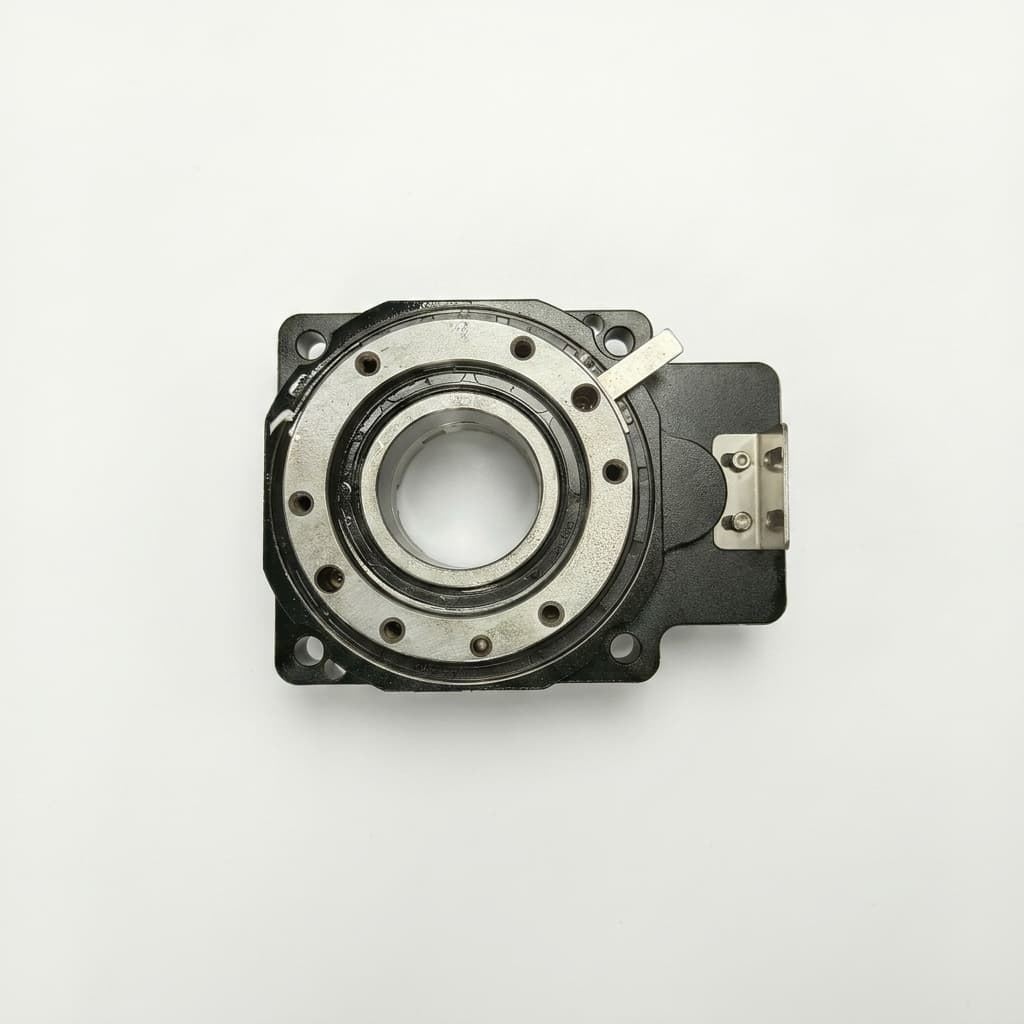
Pneumatic vs. Servo Hollow Rotary Tables: A TCO and Performance Procurement Guide
A comprehensive lifecycle and Total Cost of Ownership (TCO) analysis comparing pneumatic indexing tables with servo-driven hollow rotary tables for procurement and engineering teams.
For decades, pneumatic indexing tables were the default choice for simple rotary positioning tasks in automated assembly lines. They were cheap, robust, and mechanically straightforward. However, as modern manufacturing demands higher precision, faster changeovers, and greater energy efficiency, servo-driven hollow rotary tables have rapidly become the standard for flexible indexing stations.
When upgrading a machine or designing a new platform, engineering and procurement teams often clash over the initial capital expenditure (CAPEX). A servo-driven hollow rotary table is undeniably more expensive upfront than a pneumatic cylinder setup. But making a procurement decision based solely on the purchase order price ignores the massive operational expenditures (OPEX) associated with compressed air, maintenance, and production downtime.
This procurement guide breaks down the Total Cost of Ownership (TCO) and the engineering boundaries of both technologies, providing a clear framework for buyers, procurement teams, and system integrators to make data-driven sourcing decisions before requesting precision rotary table quotes.
Scope and verification note: Last verified on June 24, 2026. This guide applies to global industrial assembly, inspection, dispensing, and light machining support stations where the buyer must choose between pneumatic indexing and programmable servo rotary motion. It does not replace machine-safety review, ATEX/IECEx hazardous-area assessment, or final servo sizing. Recalculate energy cost with your local electricity price, compressor duty cycle, leak rate, and actual payload inertia.
The Core Technological Differences
Before evaluating costs, it is essential to establish the mechanical boundaries of both systems. The way these two technologies generate and control motion fundamentally dictates their lifecycle costs.
Pneumatic Indexing Tables
Pneumatic tables rely on compressed air acting upon pistons to drive a mechanical rack and pinion or a cam mechanism.
- Control: Bang-bang control. They typically move between hard mechanical stops.
- Positions: Limited to fixed, pre-machined indexing angles (e.g., exactly 2, 4, 6, or 8 stops).
- Feedback: Usually rely on simple proximity sensors to confirm the end of a stroke. No continuous position tracking.
- Speed Profile: Difficult to tune perfectly. Shock absorbers are often required at the end of the stroke to prevent violent impacts, which wear out over time.
Servo-Driven Hollow Rotary Tables
These systems couple a high-precision servo motor (often via a rigid gear train like a cross-roller bearing supported planetary or harmonic gear) directly to a hollow rotating platform.
- Control: Fully programmable motion profiles.
- Positions: Infinite positioning capabilities. A single table can index 3 degrees, then 90 degrees, then 12.5 degrees sequentially.
- Feedback: High-resolution closed-loop encoder feedback ensures exact positioning and immediate error detection.
- Speed Profile: Smooth S-curve acceleration and deceleration protect the tooling and the payload from shock.
Total Cost of Ownership (TCO) Breakdown
The Total Cost of Ownership evaluates the financial impact of a component over its entire expected service life (typically 5 to 10 years in industrial environments).
1. Capital Expenditure (CAPEX)
Pneumatic Systems: The initial hardware cost is very low. A pneumatic actuator, a directional control valve, and some tubing might cost a fraction of a servo system. However, the true CAPEX must also include the infrastructure required to generate compressed air—compressors, dryers, receivers, and heavy plant-wide piping. If the plant already has compressed air, this cost is "hidden," but if new capacity is needed, the CAPEX advantage disappears.
Servo Systems: The initial purchase price is higher. You are buying a precision-machined hollow rotary actuator, a servo motor, an amplifier (drive), and motion control cables. However, integration is often faster. You run power and an Ethernet/EtherCAT cable, and the system is ready to be programmed.
2. Operational Expenditure (OPEX): The Cost of Energy
This is where pneumatic systems bleed money. The U.S. Department of Energy treats compressed air as a system-level industrial energy opportunity, which is exactly why procurement should include compressor generation, distribution leaks, dryers, and maintenance load in the rotary-table cost model.
- Pneumatic Inefficiency: Compressors are notoriously inefficient. Only about 10% to 15% of the electrical energy consumed by a compressor is converted into usable pneumatic work. The rest is lost as heat. Furthermore, pneumatic lines inherently leak. A typical industrial plant loses 20% to 30% of its compressed air to undetectable leaks in fittings, seals, and hoses.
- Servo Efficiency: Servo motors consume electricity strictly on demand. When a servo hollow rotary table is holding its position, it draws minimal current. When it moves, it converts electrical energy to mechanical work with over 80% efficiency.
Over a 5-year 24/7 operating cycle, the electrical cost to run a pneumatic table can easily exceed the initial purchase price of a premium servo hollow rotary table.
3. Operational Expenditure (OPEX): Maintenance and Downtime
- Pneumatic Maintenance: Air cylinders require clean, lubricated, and dry air. If the air prep fails, water or debris destroys the cylinder seals rapidly. Furthermore, the external shock absorbers required to stop pneumatic tables degrade constantly and must be replaced on a strict preventative maintenance schedule. If a shock absorber fails mid-shift, the table slams into its hard stop, potentially destroying the tooling or the product.
- Servo Maintenance: Servo-driven hollow rotary tables are largely maintenance-free. They rely on sealed cross-roller bearings and high-grade synthetic grease that lasts for tens of thousands of hours. There are no seals to blow out and no shock absorbers to replace, drastically reducing unplanned downtime.
4. OPEX: Flexibility and Changeover Costs
In modern manufacturing, product lifecycles are shorter. A machine built today might need to assemble a completely different product in two years.
- Pneumatic Limits: If your pneumatic table was purchased for a 4-stop (90-degree) process, and the new product requires a 6-stop (60-degree) process, the entire pneumatic table must be unbolted, scrapped, and replaced.
- Servo Flexibility: With a servo hollow rotary table, changing from 4 stops to 6 stops requires simply changing a single variable in the PLC software. The mechanical hardware remains untouched. This flexibility prevents massive future capital outlays.
TCO and Performance Comparison Matrix
The following table summarizes the strategic differences when evaluating a procurement decision between the two technologies.
| Evaluation Metric | Pneumatic Indexing Table | Servo Hollow Rotary Table | Procurement Impact |
|---|---|---|---|
| Initial Hardware Cost (CAPEX) | Low ($) | High ($$$) | Pneumatics look attractive on the initial PO, but often mask system-level costs. |
| Energy Efficiency (OPEX) | Very Low (10-15% efficient) | High (>80% efficient) | Servo systems drastically reduce monthly utility bills and carbon footprint. |
| Positioning Flexibility | Fixed (Hard stops only) | Infinite (Software defined) | Servo avoids scrapping hardware during product changeovers. |
| Maintenance Burden | High (Seals, shocks, air prep) | Low (Sealed bearings, no shocks) | Servos reduce maintenance labor and replacement part inventory. |
| Load Handling (Inertia) | Poor control over heavy loads | Excellent (S-curve profiles) | Servos prevent payload damage and tooling wear from violent stops. |
| Data & Traceability | None (Blind motion) | Complete (Encoder feedback) | Servos enable Industry 4.0, predictive maintenance, and quality tracking. |
| Hollow Bore Utility | Rarely available | Large clear aperture | Servo hollow tables allow complex wiring/piping directly through the center. |
Engineering Boundaries: When Pneumatics Fail
Beyond cost, there are strict engineering boundaries where pneumatic systems simply cannot be specified. Procurement teams should automatically flag projects for Servo Hollow Rotary Tables if the engineering requirements include:
- Varying Payloads: If the weight of the fixture changes during the cycle (e.g., picking up a heavy part), a pneumatic table's speed will fluctuate wildly. Servo drives automatically compensate for inertia changes to maintain exact motion profiles.
- Fragile Components: Assembling glass, electronics, or liquids requires smooth deceleration. Pneumatic bang-bang motion causes vibrations that shatter glass or spill fluids.
- Continuous Rotation: If an application requires spinning at a constant velocity for dispensing or inspection, a pneumatic indexing table is incapable of the task.
- Data Acquisition: If the quality control system requires knowing the exact angular position of the table at a specific millisecond, servo encoder feedback is mandatory.
Procurement & Engineering Selection Checklist
Use this checklist during the design review phase before releasing a Purchase Order. If you check more than two boxes in the "Servo" column, the higher CAPEX of a servo hollow rotary table is justified by the operational requirements.
- Motion Profile: Does the application require multiple, varying stop positions? (If Yes -> Servo)
- Energy Policy: Does your facility have a mandate to reduce compressed air usage or lower carbon emissions? (If Yes -> Servo)
- Product Lifespan: Will the machine need to be repurposed for different products within the next 3 years? (If Yes -> Servo)
- Payload Sensitivity: Are you handling fragile parts or liquids that require smooth, shock-free motion? (If Yes -> Servo)
- Maintenance Access: Is the actuator located in a difficult-to-reach area where replacing shock absorbers is problematic? (If Yes -> Servo)
- Budget Constraints: Is the absolute lowest upfront cost the only driving factor, regardless of future operating costs? (If Yes -> Pneumatic)
- Simplicity: Is the environment highly explosive (ATEX) where electrical sparks are a severe hazard, and running air lines is inherently safer? (If Yes -> Pneumatic)
Frequently Asked Questions (FAQ)
1. Can a pneumatic table match the accuracy of a servo hollow rotary table?
Under specific conditions, yes. A pneumatic table relying on precision-machined hard stops can achieve very high repeatability at those specific positions. However, as the mechanical stops wear down from repeated impacts over millions of cycles, the accuracy degrades. A servo system relies on an optical or magnetic encoder, meaning its accuracy does not mechanically degrade over time.
2. We already have compressed air in our facility. Doesn't that make pneumatics cheaper?
Having the infrastructure lowers the initial CAPEX, but it does not eliminate the OPEX. Every time a pneumatic cylinder actuates, it consumes compressed air. The compressor must cycle on to replace that air, consuming electricity. Over a multi-year period, the cost of the electricity to generate that specific volume of air will typically surpass the cost of running an equivalent servo motor.
3. Are servo hollow rotary tables harder to integrate?
Historically, servo systems required specialized motion control programmers. Today, modern servo drives often feature simplified setup software, auto-tuning functions, and direct industrial Ethernet (Profinet, EtherCAT, Ethernet/IP) integration. While they require more initial programming than plugging in a pneumatic valve, the setup time has decreased significantly.
4. What size hollow bore do I need?
The primary advantage of the "hollow" rotary table is passing cables and hoses through the center, preventing tangling. Size the bore by taking the total diameter of your cable bundle and adding a minimum 30% to 50% clearance margin. A tight fit can cause friction and premature cable failure. If the application also involves machining-force loads, compare the fixture envelope against CNC 4th axis rotary table requirements rather than sizing only by bore diameter.
5. What is the typical lead time difference between the two?
Standard pneumatic tables are often off-the-shelf commodities. Servo hollow rotary tables, especially high-precision or high-torque variants, may have lead times ranging from 2 to 6 weeks depending on the supplier and the specific gear ratio required.
Sources and Reference Basis
This article combines supplier-side rotary-table selection criteria with public compressed-air energy guidance. The sources below were used to cross-check the cost and specification logic; final values must still be validated against the exact duty cycle, local utility rate, and selected actuator model.
- U.S. Department of Energy: Compressed Air Systems - used for compressed-air system framing and energy-review context.
- Sango Automation: How to Select Hollow Rotary Table - used for hollow rotary table selection terminology and sizing considerations.
- Oriental Motor: Hollow Rotary Actuators - used for supplier terminology around hollow rotary actuators, positioning, and through-bore product boundaries.
Conclusion and Next Steps
The transition from pneumatic to electric actuation is a permanent shift in modern automation. While pneumatic tables will always have a place in ultra-low-cost, simple, two-position applications, the overarching demands of modern manufacturing—flexibility, data traceability, and energy efficiency—heavily favor Servo Hollow Rotary Tables.
Procurement professionals must look beyond the initial invoice. By calculating the Total Cost of Ownership—factoring in energy consumption, reduced maintenance, and the elimination of shock absorber replacements—the ROI for servo systems becomes undeniable, often paying for the premium within the first 18 to 24 months.
Ready to validate a servo upgrade for your next machine? If you are transitioning a legacy pneumatic platform and need assistance sizing the inertia, torque, and calculating the exact TCO for your application, our engineering team can help.
Reach out through the servo rotary table inquiry page or email [email protected] to request a customized sizing evaluation or to receive CAD models for your initial design phase.
Author

Categories
More Posts
Inertia Mismatch in Servo Rotary Tables: A Sizing & Procurement Guide
Learn how inertia mismatch affects servo hollow rotary tables, calculate ratios, avoid tuning failure, and ask suppliers for the right sizing proof before RFQ.

2026-W25 Servo Rotary Sourcing: New Compliance Gates & Sizing Safeguards
Week-25 buyer brief for servo hollow rotary tables: EU 12-month sanction extension, USTR forced labor duty proposals, pneumatic air compressor anti-dumping risk, and bore/load sizing rules.
IP67 vs IP69K Servo Rotary Actuators: A Procurement and Specification Guide
Compare IP67 vs IP69K servo rotary actuators for washdown duty, dynamic seal risks, chemical limits, and supplier questions before RFQ.