
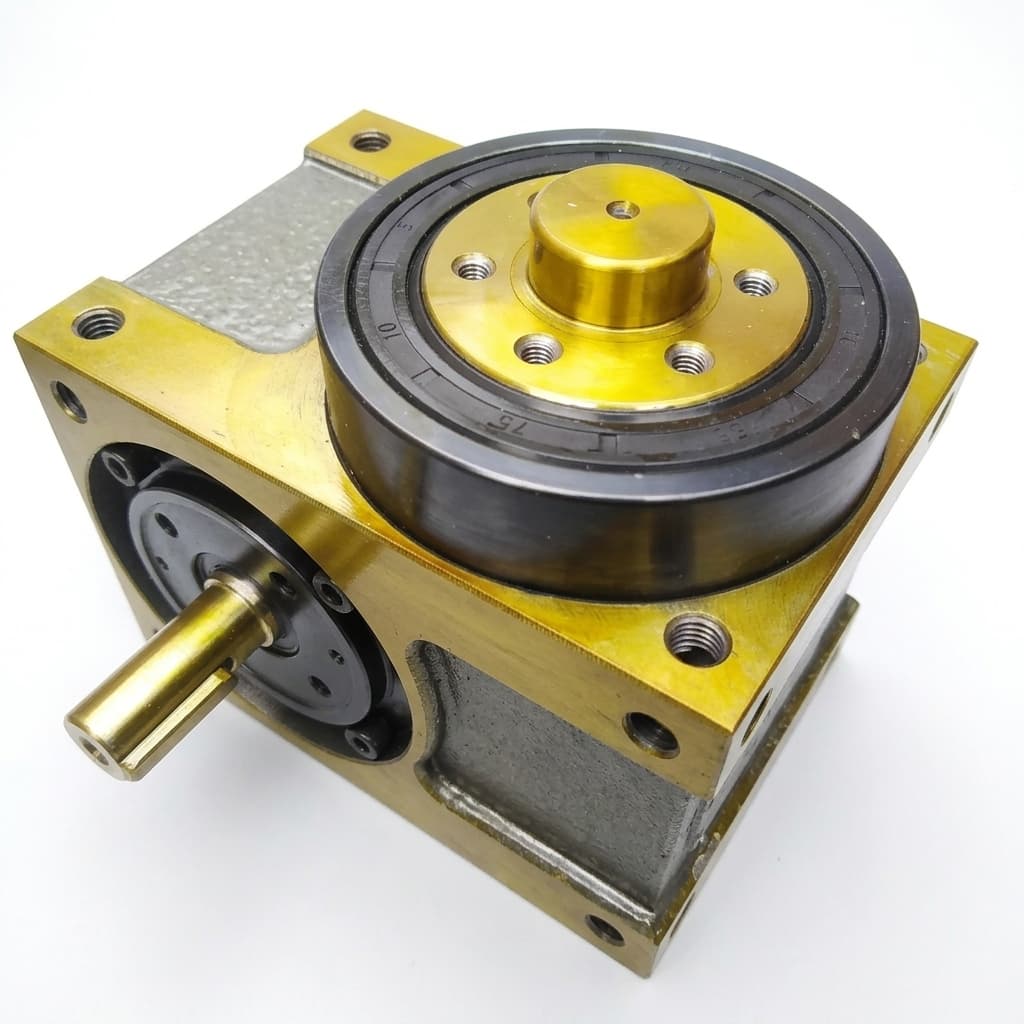
Direct Drive vs Servo Hollow Rotary Tables: A Procurement and TCO Comparison
Direct Drive Rotary vs Servo Hollow Rotary Tables for precision indexing: compare backlash, inertia, tuning effort, lead-time risk, and TCO before RFQ.
For machine builders, OEMs, and procurement teams evaluating rotary indexers, the choice often boils down to two dominant technologies: Direct Drive Rotary (DDR) motors and Servo Hollow Rotary Tables. Making the wrong choice can either blow up your bill of materials (BOM) cost or leave your engineering team fighting resonance and tuning issues for weeks on the factory floor.
While DDR motors offer the allure of absolute zero backlash and extreme dynamic response, they introduce significant hidden costs in servo tuning, thermal management, and inertia matching. Conversely, Servo Hollow Rotary Tables—which utilize precision internal gearing—offer a highly forgiving, cost-effective alternative that meets the precision requirements of 80% to 90% of industrial automation applications.
Scope note, last verified July 22, 2026: This comprehensive guide is designed for global buyers, procurement teams, distributors, importers, and mechanical engineers. It provides a total cost of ownership (TCO) and technical capability comparison between direct drive systems and geared servo hollow rotary actuators. It should be used for vendor evaluation, specification drafting, and system design optimization.
1. Key Conclusions for Procurement and Engineering
Before diving into the mechanical deep-end, here are the executive takeaways for decision-makers:
- Avoid Over-Specifying Precision: If your application can tolerate 1 to 3 arc-minutes of backlash (which is typical for high-end hollow rotary tables), paying a 200% to 300% premium for a DDR motor is unnecessary and wasteful.
- Inertia Mismatch is the Silent Killer of DDR: DDR motors struggle profoundly with high inertia mismatch (the ratio of load inertia to rotor inertia). Geared hollow rotary tables use the gear reduction ratio squared ($i^2$) to easily manage massive external loads without tuning instability.
- Engineering Time is a Tangible Cost: DDR integration requires advanced servo tuning to eliminate hunting, resonance, and settling time issues. Servo hollow rotary tables are generally "plug-and-play" by comparison, saving days of costly engineering labor.
- Form Factor Synergy: Both technologies offer a large center bore (hollow shaft) for routing cables, pneumatics, and optical lines, meaning machine layout does not have to be compromised regardless of the chosen technology.
- Supply Chain Flexibility: Hollow rotary tables are modular. You can source the mechanical table from one vendor and the servo motor from your preferred, globally stocked automation partner (e.g., Siemens, Yaskawa, Allen-Bradley). DDR systems often lock you into a single-vendor, proprietary drive ecosystem.
2. Understanding the Core Technologies
To make an informed procurement decision, buyers and engineers must align on the fundamental mechanical differences between these two rotary indexers.
Direct Drive Rotary (DDR) Motors
A Direct Drive Rotary motor (often referred to as a torque motor) eliminates all mechanical power transmission components, such as gears, belts, or pulleys. The payload is bolted directly to the motor's rotor.
- The Good: Because there are no mechanical linkages, there is absolute zero mechanical backlash, zero gear wear, whisper-quiet operation, and the ability to achieve sub-arc-second positioning accuracy. They excel in dynamic, high-speed, short-stroke applications.
- The Bad: Without gear reduction to multiply torque, DDR motors must rely entirely on their electromagnetic design to generate force. To get high torque, the motor must be physically very large in diameter. Furthermore, because the motor is directly coupled to the load, the control loop feels the full, unmitigated inertia of the tooling. This makes the system highly sensitive to changes in mass and requires specialized servo drives.
Servo Hollow Rotary Tables (Geared)
A Servo Hollow Rotary Table pairs a standard industrial AC servo motor (or closed-loop stepper motor) with a highly precise internal gear train—usually a planetary or harmonic gear system. This gear train is supported by a heavy-duty cross-roller bearing designed to handle massive axial and radial loads.
- The Good: The gear reduction acts as a mechanical lever, multiplying the motor's torque and drastically reducing the reflected inertia of the load back to the motor. This allows a physically smaller, cheaper motor to effortlessly control a massive rotating dial or robotic arm. They are robust, easy to tune, and highly cost-effective.
- The Bad: Gears inherently introduce a tiny amount of backlash (typically 1 to 3 arc-minutes) and introduce a wear mechanism over millions of cycles. While high-quality tables minimize this, they can never achieve the absolute zero backlash of a DDR.
3. Deep Dive: Inertia Mismatch and the Engineering Cost
The most critical factor separating these two technologies is how they handle Inertia Mismatch.
Inertia mismatch is the ratio of the load's moment of inertia to the motor rotor's moment of inertia. When this ratio is too high, the motor cannot control the load effectively. When the motor tries to stop at a precise position, the momentum of the heavy load forces it past the target. The servo drive detects this error and reverses the motor to correct it, but overshoots again. This creates a rapid, audible vibration known as "hunting" or resonance.
The DDR Vulnerability
Direct Drive motors are directly coupled to the load. They feel 100% of the load's inertia. As a rule of thumb, DDR manufacturers recommend keeping the inertia mismatch below 10:1 (and in highly dynamic applications, below 5:1). If you are rotating a massive 1-meter steel dial filled with heavy fixtures, the inertia will be enormous. To keep the ratio below 10:1, you must purchase a massive, incredibly expensive DDR motor with a very heavy rotor just to satisfy the math.
Furthermore, if the load changes during operation (e.g., robotic arms picking up varying weights, or dials being loaded/unloaded with parts), the DDR motor's tuning parameters become unstable. Engineers must spend days configuring complex notch filters and feed-forward algorithms to keep the machine from vibrating.
The Hollow Rotary Table Advantage
This is where geared Servo Hollow Rotary Tables shine. A gear reducer acts as an "inertia eraser." The reflected inertia of the load back to the motor is reduced by the square of the gear ratio ($1/i^2$).
For example, if you use a hollow rotary table with a 10:1 internal gear ratio, the motor feels a load that is 100 times smaller than the actual physical load. This mathematical magic allows a very small, inexpensive, standard 400W servo motor to effortlessly control a massive, heavy dial without any tuning instability. The motor simply does not feel the burden of the heavy load, making it inherently stable and incredibly easy to tune using standard auto-tuning software.
4. Thermal Management and Duty Cycles
Another frequently overlooked aspect in the DDR vs. Hollow Rotary debate is thermal management.
DDR Motors: Because they lack a mechanical advantage, DDR motors must draw significant continuous current to hold a heavy load in place or to perform high-torque moves. This current generates immense heat directly at the stator. Because the load is bolted directly to the motor, this heat transfers directly into the tooling and the machine frame. In high-precision applications, this thermal expansion can distort tooling and ruin the very precision you paid a premium for. Many high-end DDRs require complex liquid cooling jackets to mitigate this.
Servo Hollow Rotary Tables: Geared tables physically separate the servo motor from the rotary dial. The motor is mounted to the side or bottom of the gearhead housing. Furthermore, because the gear ratio multiplies the torque, the motor draws significantly less continuous current to hold or move the load. Less current means less heat, and the physical separation ensures that whatever minimal heat is generated does not conduct directly into the precision tooling.
5. Component and Performance Comparison Table
To facilitate a quantitative procurement evaluation, the following table compares typical specifications and TCO factors between the two architectures for a standard 200mm diameter indexing application.
| Feature / Metric | Direct Drive Rotary (DDR) | Servo Hollow Rotary Table |
|---|---|---|
| Mechanical Backlash | 0 arc-sec (Absolute Zero) | 1 ~ 3 arc-min (depending on gear type) |
| Positioning Accuracy | ± 15 to ± 30 arc-sec | ± 1 to ± 2 arc-min |
| Torque Generation | Low to Moderate (Requires large diameter for high torque) | High (Multiplied by internal gear ratio, e.g., 5:1, 10:1, 18:1) |
| Inertia Handling | Poor (Max 10:1 mismatch recommended) | Excellent (Gear ratio squared reduction allows 100:1 or 200:1 mismatch) |
| Servo Tuning Difficulty | High (Requires notch filters, anti-resonance tuning, expert engineers) | Low (Standard auto-tuning algorithms usually suffice) |
| Thermal Output | High (Direct heat transfer to load) | Low (Separated motor, lower current draw) |
| Unit Hardware Cost | $$$$ (High Premium) | $$ (Highly Cost-Effective) |
| Total Cost of Ownership (TCO) | High (Hardware + Extensive Engineering Time + Custom Drives) | Low (Standard Hardware + Fast Integration + Off-the-shelf Drives) |
6. TCO and Sizing Checklist for Procurement
When reviewing a Bill of Materials or evaluating a machine upgrade, procurement managers and engineers should walk through this checklist before authorizing a purchase order.
Engineering & Design Checklist
- Calculate the True Load Inertia: Have we accurately calculated the moment of inertia for the rotary dial and all mounted tooling?
- Determine the Actual Precision Required: Do we truly need sub-arc-minute precision? (Often, the cumulative mechanical tolerance of the aluminum dial and fixtures exceeds the actuator's backlash anyway, rendering the DDR's extreme precision useless in reality).
- Evaluate Load Dynamics: Will the mass of the load change significantly during the machine's cycle (e.g., adding heavy parts to the dial)? Note: Changing loads destabilize DDR motors much faster than geared rotary tables.
- Assess Thermal Sensitivity: Will heat transferred from a DDR motor affect the tolerances of our payload or tooling?
Procurement & Supply Chain Checklist
- Compare Drive Compatibility: Does the DDR motor require a proprietary servo drive from the manufacturer, or can it run on our standard factory platform (e.g., Siemens, Allen-Bradley, Beckhoff, Omron)? Servo hollow rotary tables can typically mount to any brand of servo motor via an adapter flange.
- Assess Lead Times: DDR motors often have 12-to-20 week lead times and are sensitive to rare-earth magnet shortages. Standard hollow rotary tables and their corresponding servo motors are frequently stocked globally.
- Review Lifecycle and Labor Costs: Have we factored in the engineering labor required for DDR commissioning, tuning, and troubleshooting compared to the plug-and-play nature of a geared actuator?
7. Application Boundary Conditions: When to Use Which
Knowing when a technology will fail or underperform is just as important as knowing its strengths.
When to ONLY use Direct Drive (DDR)
- Semiconductor Wafer Inspection: Applications requiring nanometer-level path tracking, continuous smooth scanning without velocity ripple, and absolute zero hysteresis.
- Continuous High-Speed Rotation: Spindles, optical coaters, or testing centrifuges running continuously at high RPMs (e.g., 500+ RPM) where mechanical gear wear would occur too rapidly.
- Zero-Settling-Time Indexing: When the indexer must move fast, stop, and immediately trigger a high-resolution camera without a single millisecond of settling vibration.
When to ONLY use Servo Hollow Rotary Tables
- High Inertia Rotary Dials: Automated assembly machines with massive aluminum dials (e.g., 800mm to 1500mm diameter) carrying heavy fixtures. A DDR motor would need to be astronomically large to handle this inertia, whereas a hollow rotary table handles it easily.
- Unbalanced or Eccentric Loads: Applications where the center of gravity shifts drastically during operation (e.g., robotic welding positioners, heavy payload manipulators). The gear reduction acts as a shock absorber against these disturbances.
- Budget-Constrained OEM Machines: When standardizing a machine line for high-volume sales, the drastic cost reduction of a hollow rotary table directly improves OEM profit margins without sacrificing acceptable industrial performance.
8. Risks and Trade-offs
Procurement decisions are exercises in risk management. Consider the following trade-offs when making your final selection:
Risk: Over-engineering the Solution (Paying for unused specs)
- Trigger: Specifying a DDR motor for standard packaging, labeling, or general assembly lines.
- Mitigation: Demand that the engineering team prove mathematically why 1 arc-minute of backlash is unacceptable for the specific process. In 90% of cases, the mechanical compliance of the machine frame and tooling nullifies the DDR's accuracy advantage.
Risk: Resonance and "Hunting" on the Factory Floor
- Trigger: A DDR motor paired with a highly compliant (flexible) load, or an application with massive inertia mismatch.
- Mitigation: If the calculated inertia mismatch exceeds 10:1, transition immediately to a Servo Hollow Rotary Table. The gear reduction will mathematically erase the load's reflected inertia, instantly stabilizing the system and saving weeks of troubleshooting.
Risk: Vendor Lock-in and Supply Chain Fragility
- Trigger: Purchasing a proprietary DDR system with a paired, closed-source drive architecture.
- Mitigation: Opt for a modular Servo Hollow Rotary Table where the mechanical actuator is separate from the servo motor. This allows you to mount a motor from your preferred, localized vendor and avoids single-source supply chain bottlenecks.
9. Frequently Asked Questions (FAQ)
Can a Servo Hollow Rotary Table achieve the same accuracy as a DDR?
No. Because a servo hollow rotary table utilizes physical gears, there will always be a microscopic amount of mechanical backlash (typically 1 to 3 arc-minutes). While this is incredibly precise and sufficient for almost all industrial tasks, if your application demands absolute zero backlash and sub-arc-second repeatability (like semiconductor manufacturing), DDR is the only physical solution.
Why does "Inertia Mismatch" matter so much more for DDR than for geared tables?
In a DDR, the motor feels 100% of the load's inertia directly. If the load is too massive, the servo amplifier struggles to stop the load without overshooting the target position, causing vibration. In a geared table, the load's inertia is divided by the square of the gear ratio ($1/i^2$) before it reaches the motor, making the motor feel as though it is moving a much lighter, highly controllable object.
Is the hollow bore size different between the two technologies?
Both technologies offer generous hollow bores for routing cables, air lines, and pneumatics. However, because DDR motors rely on a large outer diameter to generate torque (since they lack torque-multiplying gears), they often inherently feature very large hollow bores compared to a similarly torqued geared table.
Do geared Hollow Rotary Tables require extensive maintenance?
Most modern, high-quality servo hollow rotary tables are lubricated with synthetic lifetime grease at the factory and are fully sealed. Under normal operating conditions and within specified load limits, they are considered maintenance-free for their specified lifespan (typically 20,000+ operating hours).
Can I use my existing servo drives with a Hollow Rotary Table?
Yes. One of the greatest procurement advantages of a hollow rotary table is its modularity. You can specify a motor adapter flange to fit virtually any standard servo motor (Siemens, Yaskawa, Panasonic, Delta, Mitsubishi). This allows you to maintain your factory's existing PLC and drive architecture without introducing new, proprietary DDR drive software to your controls engineers.
10. Sources and References
To verify the technical claims, inertia math, and data points in this guide, refer to the following industry engineering sources:
- PlanetDrivePro: Rotary Actuator Types and Selection Guide – A comprehensive overview of the balance between cost, practical accuracy, and gear-driven dynamics.
- DematTec Automation: What is the difference between a DD motor and a hollow rotary platform? – Detailed analysis of high rigidity, tuning complexity, and cost-performance ratios in hollow rotary platforms versus DD motors.
- Oriental Motor: Rotary Actuators and Hollow Rotary Gearheads – Technical documentation on how geared hollow rotary actuators allow for highly accurate positioning of large inertia loads without resonance.
11. Next Steps and Action Items
Taking the right next step depends on your specific role in the organization:
For Procurement Managers and Sourcing Teams:
- Audit your current BOMs: Identify any machines utilizing Direct Drive motors and request a formal engineering justification for the zero-backlash requirement.
- De-risk your supply chain: Standardize on modular Servo Hollow Rotary Tables that allow you to use your preferred, locally stocked servo motor brands.
For Mechanical and Controls Engineers:
- Run the Math: Use the ServoRotary buyer guide library to review sizing methods for load inertia and inertia mismatch before blindly selecting an actuator.
- Stabilize your System: If your load inertia mismatch exceeds 10:1, specify a Servo Hollow Rotary Table with a 5:1 or 10:1 ratio to ensure stable, oscillation-free operation from day one.
Ready to optimize your rotary indexing system and drastically reduce your BOM cost? Explore our complete range of high-rigidity, cost-effective Servo Hollow Rotary Tables or contact our application engineering team today to review your sizing calculations and get a competitive RFQ.
Author

Categories
More Posts
Pneumatic vs. Servo Hollow Rotary Tables: A TCO and Performance Procurement Guide
A comprehensive lifecycle and Total Cost of Ownership (TCO) analysis comparing pneumatic indexing tables with servo-driven hollow rotary tables for procurement and engineering teams.
IP67 vs IP69K Servo Rotary Actuators: A Procurement and Specification Guide
Compare IP67 vs IP69K servo rotary actuators for washdown duty, dynamic seal risks, chemical limits, and supplier questions before RFQ.
Battery-less vs. Battery-Backed Encoders in Servo Rotary Tables: A TCO Guide
Discover why procurement teams are switching to battery-less absolute encoders for servo rotary actuators. Compare TCO, maintenance costs, and integration requirements.