
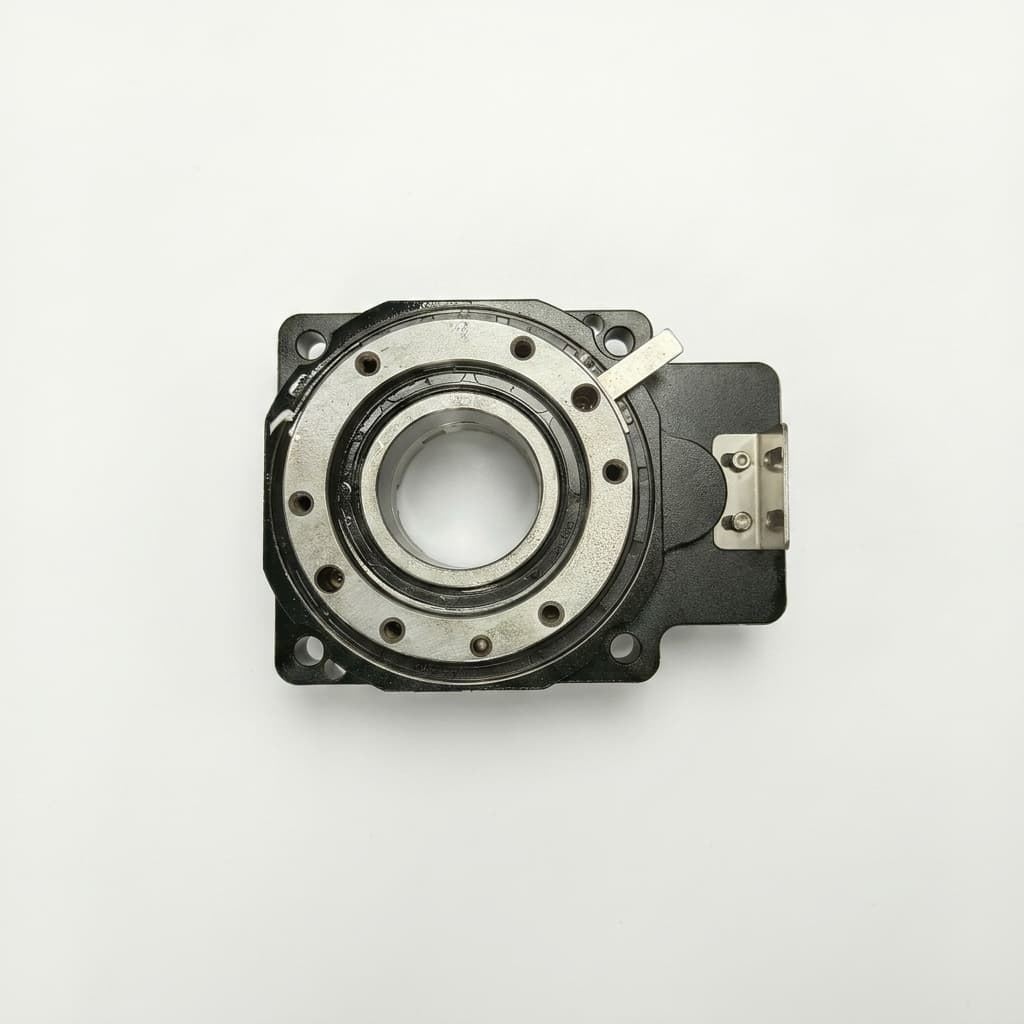
Battery-less vs. Battery-Backed Encoders in Servo Rotary Tables: A TCO Guide
Discover why procurement teams are switching to battery-less absolute encoders for servo rotary actuators. Compare TCO, maintenance costs, and integration requirements.
When procurement teams and engineering managers evaluate servo hollow rotary tables, the choice of encoder technology often dictates the long-term Total Cost of Ownership (TCO). Historically, automation systems relied on battery-backed absolute encoders to retain position data during power loss. However, as of 2026, the transition towards battery-less absolute encoders (utilizing mechanical multi-turn gears or energy harvesting technologies) has fundamentally altered maintenance schedules.
Should you pay the 15% to 25% premium for a battery-less servo rotary actuator, or stick to the legacy battery-backed standard?
The core takeaway: For high-uptime applications (like semiconductor manufacturing, packaging, and automotive assembly), the battery-less premium pays for itself within the first maintenance cycle. However, for cost-sensitive, low-duty-cycle equipment, standard incremental or battery-backed systems may still offer a lower initial CAPEX.
Last Updated & Verified: July 2026.
Scope, Method, and Decision Assumptions
This guide is written for global OEM procurement teams, controls engineers, and machine builders specifying servo rotary actuators or servo hollow rotary tables for indexing, fixture rotation, packaging, electronics assembly, semiconductor handling, and automotive automation cells.
The TCO model below uses a 10-year machine life, 1-3 year battery replacement intervals for battery-backed systems, $20-$50 replacement battery cost, $100/hour skilled maintenance labor, and a sample 30-axis automation line. Treat those as decision assumptions, not universal pricing. Replace them with your plant's labor rate, downtime cost, axis count, ambient temperature, and accepted homing risk before releasing a purchase order.
For a live RFQ, ask suppliers to quote the same rotary table frame with incremental, battery-backed absolute, and battery-less absolute encoder options so purchasing and engineering can compare CAPEX, downtime exposure, and drive compatibility on the same basis.
Key Conclusions for Procurement
- Zero Battery Maintenance OPEX: Battery-less encoders eliminate the material cost of replacement batteries, the labor cost to swap them, and the administrative burden of international battery shipping compliance.
- Elimination of Homing Routines: Both battery-backed and battery-less systems eliminate the need for "return-to-home" sequences upon startup. However, if a battery-backed system's battery dies during power-down, position data is lost, triggering unexpected homing downtime.
- Environmental Robustness: Without a chemical battery (which degrades rapidly above 55°C), battery-less encoders thrive in high-temperature or vacuum environments where standard batteries fail prematurely.
- Initial CAPEX Premium: Expect a 15% to 25% higher upfront cost for the motor/encoder package when specifying mechanical battery-less technology compared to standard optical incremental encoders.
Visualizing Encoder Architectures
The architectural difference explains why battery-less systems offer higher reliability. A battery-backed system relies on continuous electrical power (even when the machine is off) to count rotations. A battery-less mechanical absolute encoder uses physical gears (similar to a clock) or Wiegand-effect sensors to passively track position.
Visual reference: Battery-less encoders use mechanical gear tracking (or Wiegand wire) instead of continuous battery power to track rotation counts when the machine is shut down.
TCO Decision Matrix: Which Encoder to Specify
To prevent over-specification or future OPEX blowouts, buyers must align the encoder choice with the machine's operational profile.
| Technical Specification | Standard Incremental | Battery-Backed Absolute | Battery-Less Absolute | Supplier Communication Field (RFQ) |
|---|---|---|---|---|
| Initial CAPEX Impact | Baseline (Lowest Cost) | +10% to +15% | +15% to +25% | "Quote both incremental and battery-less options." |
| Homing Requirement | Mandatory on every startup | Not required (unless battery dies) | Never required | "Is homing acceptable in this machine cell?" |
| Maintenance OPEX | Zero | High (Replace batteries every 1-3 years) | Zero | "Provide battery replacement schedule and part costs." |
| Position Retention | Volatile (Lost on power off) | Battery-dependent | Permanent (Mechanical/Magnetic) | "Does the actuator need to retain multi-turn data?" |
| Temperature Tolerance | Excellent | Poor (Batteries degrade rapidly >55°C) | Excellent (Up to 85°C+) | "Specify ambient operating temperature." |
| Logistics/Shipping | Unrestricted | Restricted (Lithium battery air transport laws) | Unrestricted | "Are there export restrictions on the motor drive?" |
Note: Cost premiums are based on 2026 market averages for servo hollow rotary tables. Always confirm final pricing directly with your supplier network.
If the battery-less premium is smaller than one planned maintenance visit plus one unplanned homing recovery, keep the battery-less option in the commercial shortlist instead of treating it as an engineering luxury.
The Hidden Costs of Battery Maintenance
When procurement looks only at the purchase price, battery-backed systems appear to be a cost-effective compromise. However, the Total Cost of Ownership tells a different story.
1. The Cost of the Battery Itself
While a single lithium backup battery might cost $20 to $50, an automation line with 30 servo rotary indexing platforms will incur a material cost of $600 to $1,500 every 12 to 24 months. Over a 10-year lifespan, this adds thousands to the OPEX budget.
2. The Labor and Downtime Cost
Batteries do not replace themselves. A maintenance technician must schedule downtime, power down the drive (or keep control power alive depending on the architecture), physically replace the battery, and sometimes re-calibrate the home position. At $100/hour for skilled labor and potentially thousands of dollars per hour in lost production, a single battery swap sequence eclipses the initial CAPEX premium of a battery-less encoder.
3. The Risk of Unplanned Homing
If a battery dies during a holiday shutdown, the servo drive loses its multi-turn absolute position. Upon startup, the rotary table must execute a homing routine. In complex automation (e.g., semiconductor wafer indexing), the table cannot freely rotate to find a home switch without colliding with tooling. Operators must manually decouple the load—a massively time-consuming failure mode.
Boundaries and Limitations: When NOT to Use Battery-Less
Despite their advantages, mechanical battery-less absolute encoders are not a universal panacea. You must understand their boundaries:
- Ultra-High Speed Limitations: Because mechanical absolute encoders rely on physical gears spinning at high speeds inside the encoder housing, they can sometimes introduce minor friction and have lower maximum RPM limits compared to purely optical incremental encoders.
- Form Factor Constraints: The internal gear train or energy-harvesting module adds slight length to the servo motor housing. If your application has extreme space constraints, a battery-less motor might be 10-20mm longer than an incremental equivalent.
- Resolution Ceilings: While high enough for 95% of automation tasks, ultra-precision applications requiring >24-bit resolution may still lean towards specialized optical absolute encoders (which often require batteries).
Procurement & Engineering Checklist
Do not release a PO for a new precision rotary table without verifying the following points with your automation vendor:
- Verify Homing Clearance: If using an incremental encoder to save money, confirm that the rotary table has enough mechanical clearance to execute a homing routine without crashing into adjacent tooling.
- Check Drive Compatibility: Ensure your selected servo drive (e.g., EtherCAT, PROFINET) explicitly supports the battery-less encoder protocol (such as EnDat 2.2, BiSS-C, or proprietary formats).
- Calculate the Break-Even Point: Compare the battery-less premium against the cost of 3 battery replacements + labor. If the premium is less, upgrade to battery-less immediately.
- Confirm Environmental Temps: If the machine ambient temperature exceeds 55°C, disqualify battery-backed systems immediately, as lithium batteries will fail prematurely.
- Check Supply Chain Lead Times: Verify if the battery-less motor variant has the same lead time as the standard variant, as supply chains for battery-less chips can occasionally tighten.
Frequently Asked Questions (FAQ)
Q: Do battery-less absolute encoders lose position if the power is off for years?
A: In the architectures covered here, mechanical multi-turn encoders use physical gears, and Wiegand-effect designs use magnetic energy harvesting rather than a backup battery. They are intended to retain position without control power, but you should still verify the supplier's specified retention behavior and reset procedure for the exact actuator model.
Q: Are battery-less encoders more susceptible to vibration?
A: Not automatically. The risk depends on the encoder architecture, shaft support, motor housing, cable exit, and application vibration profile. Ask for the actuator vibration rating and test standard instead of assuming every battery-less encoder behaves the same way.
Q: We use EtherCAT. Can we drop a battery-less servo into our existing EtherCAT network?
A: The fieldbus (EtherCAT) is independent of the encoder. As long as the servo drive is EtherCAT-compatible and can read the motor's battery-less encoder, the PLC will not notice the difference. You simply will not have to program a "low battery warning" alarm.
Q: Why don't all manufacturers use battery-less technology?
A: Cost, product platform history, drive compatibility, certification scope, and supply-chain continuity all matter. Some manufacturers keep optical disk + battery architectures because they are proven, compact, and easier to price aggressively in base servo packages.
Sources and Verification Notes
These references were checked for relevance on July 26, 2026. They support the encoder technology background and the battery-maintenance risk framing, while the cost and break-even assumptions above must still be validated against supplier quotations.
- Oriental Motor battery-free absolute encoder technology — manufacturer explanation of battery-free absolute positioning and homing-related benefits.
- MOONS' battery-less absolute encoder applications — manufacturer application page for battery-less absolute encoder use cases in motion systems.
- Machine Design rotary encoder technology overview — engineering background on rotary encoder types and absolute/incremental selection trade-offs.
Future-Proof Your Automation Lines
Specifying the correct servo hollow rotary table is about maximizing OEE (Overall Equipment Effectiveness) while minimizing maintenance headaches. If your facility is tired of tracking battery replacement schedules and suffering through accidental homing crashes, battery-less technology is the definitive solution.
Our engineers can help you compare the TCO of standard and battery-less servo architectures. Contact our technical sales team for an evaluation, and ensure your next rotary indexing platform is genuinely maintenance-free.
Author

Categories
More Posts
Servo Motor Compatibility Checklist Before PO
Use this pre-PO checklist to verify flange, inertia, encoder, and control assumptions before locking a rotary table supplier.
2026-W21 Rotary Sourcing Update: Compliance and Quality Gates Before PO Release
Week-21 brief for servo hollow rotary tables: U.S./EU compliance shifts, APAC supplier signals, and PO-release actions for bore/load and positioning decisions.
2026-W20 Rotary Sourcing Update: Tariff Risks
Week-20 buyer brief on servo hollow rotary tables: U.S./EU trade-rule shifts, bore/load exposure points, and RFQ controls buyer teams must lock this week.