
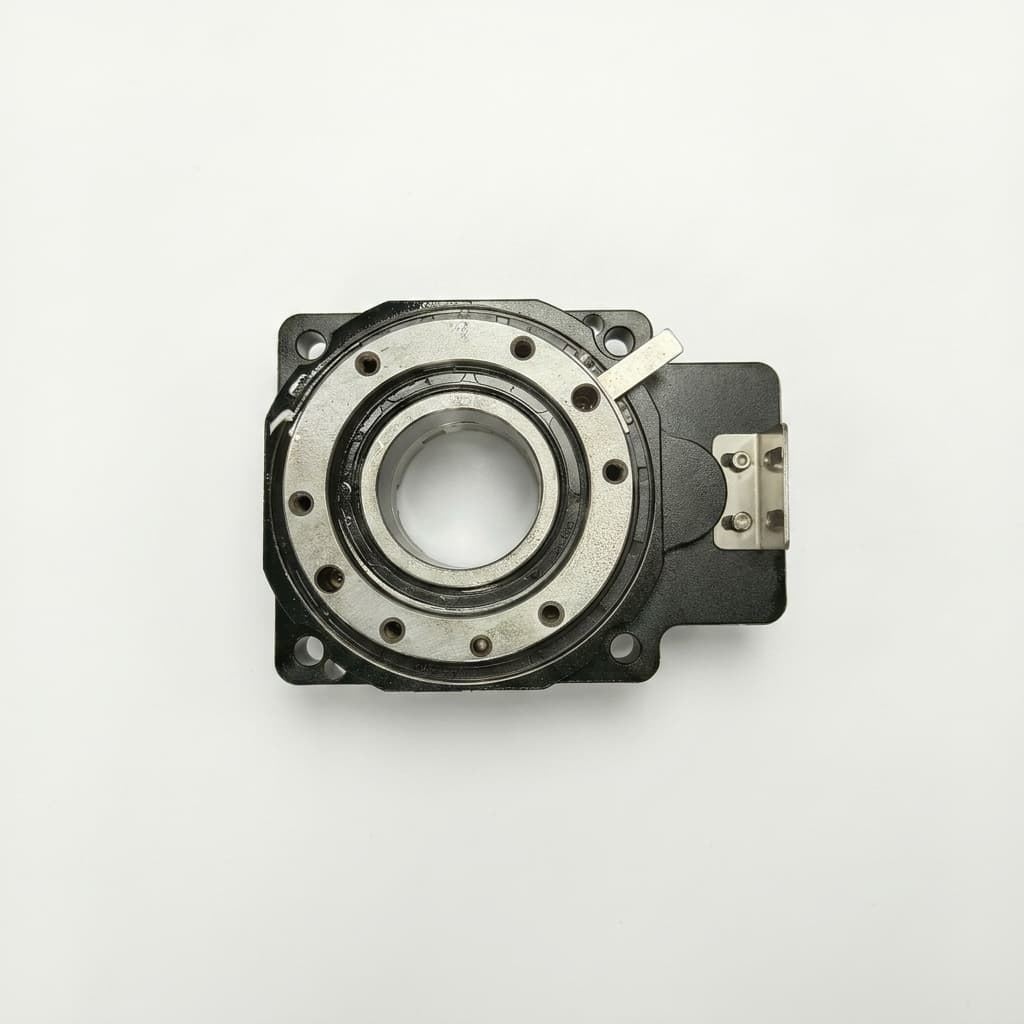
Inertia Mismatch in Servo Rotary Tables: A Sizing & Procurement Guide
Learn how inertia mismatch affects servo hollow rotary tables, calculate ratios, avoid tuning failure, and ask suppliers for the right sizing proof before RFQ.
When procurement teams and mechanical engineers collaborate to source servo hollow rotary tables, they often hyper-focus on two metrics: maximum payload capacity (in kilograms) and positional accuracy (in arc-minutes). However, there is a third, critically important metric that is frequently overlooked until the machine is built and failing on the factory floor: Inertia Mismatch.
Specifying a servo rotary actuator based solely on the static weight of the load without calculating the mass moment of inertia is the leading cause of tuning failures, violent machine vibrations, and premature bearing destruction.
The core takeaway for buyers: If the inertia of your tooling plate and payload is drastically larger than the inertia of your servo motor's rotor, the servo drive will be unable to control the load dynamically. It will overshoot, oscillate, and eventually trigger a fault. This guide provides a comprehensive framework for buyers and engineers to understand inertia matching, ask the right questions during the RFQ process, and source the correct rotary indexer without overpaying for unnecessary motor bulk.
Last Updated & Verified: July 24, 2026.
Scope note: This guide is for global machine builders, automation OEMs, system integrators, and procurement teams sourcing servo rotary actuators for indexing, assembly, inspection, welding, and fixture-positioning systems. The ratio bands below are procurement screening ranges, not universal acceptance criteria. Final sizing must be verified against the supplier's motor rotor inertia, reducer ratio, CAD-derived load inertia, duty cycle, drive tuning limits, and required settling-time acceptance test.
1. What is Inertia Mismatch in Rotary Systems?
To make informed purchasing decisions, procurement professionals must understand the basic physics governing servo-driven rotary platforms.
Inertia is an object's resistance to any change in its velocity. In rotary systems, this is called the mass moment of inertia. It dictates how much torque is required not just to hold a load, but to accelerate it up to speed and, more importantly, to decelerate it to a precise stop within milliseconds.
Inertia Mismatch (or Inertia Ratio) is the ratio between the inertia of the external load (the rotating dial plate, fixtures, and the parts being manufactured) and the inertia of the servo motor's internal rotor.
Inertia Ratio = J_load / J_motor
Where:
- J_load = Mass moment of inertia of the load reflected back to the motor shaft.
- J_motor = Mass moment of inertia of the servo motor's rotor.
Why the Gearbox Changes Everything
Hollow rotary tables typically integrate a gear reduction stage. The gearbox acts as an "inertia matcher." The load inertia reflected back to the motor is reduced by the square of the gear ratio (i^2).
J_reflected = J_actual_load / i^2
If you have a 10:1 gear ratio, the load inertia felt by the motor is reduced by a factor of 100. This is why geared rotary actuators are so critical for handling massive dial tables with relatively small, cost-effective servo motors.
Fast Screening Example for an RFQ Review
Use this simplified example to see why the gearbox ratio can change a sourcing decision:
- A 12 kg aluminum dial plate with a 600 mm diameter has an approximate solid-disk inertia of J = 1/2 x m x r^2 = 0.54 kg-m^2.
- Four fixtures add another 8 kg with centers roughly 220 mm from the axis: J = m x r^2, or about 0.39 kg-m^2.
- The actual rotary load is therefore about 0.93 kg-m^2 before reducer reflection.
- With a 10:1 reducer, the reflected load inertia is about 0.0093 kg-m^2; with an 18:1 reducer, it drops to about 0.0029 kg-m^2.
- If the proposed servo motor rotor inertia is 0.0008 kg-m^2, the sourcing choice moves from an 11.6:1 inertia ratio to a 3.6:1 ratio.
Procurement interpretation: in this example, changing the reducer ratio can move the actuator from a moderate tuning-risk quote to a low-risk quote without jumping to a larger motor frame. Always confirm that the higher ratio still meets the required top speed and cycle time.
2. Visualizing the Impact of Inertia on Servo Tuning
When the inertia ratio is too high, the servo drive's PID (Proportional-Integral-Derivative) control loop struggles to manage the load. The motor applies torque to stop the table, but the massive momentum of the dial plate forces it past the target position. The motor then aggressively reverses to correct the error, causing a violent oscillation known as "ringing."
Visual reference: A mismatched inertia ratio forces the servo drive to continuously fight the load's momentum, resulting in extended settling times, vibration, and ultimately, rejected parts on the assembly line.
3. The Acceptable Limits: How Much is Too Much?
There is no universal "perfect" inertia ratio. The acceptable limit depends entirely on the application's required dynamics, the rigidity of the machine frame, and the sophistication of the servo drive's auto-tuning algorithms.
For buyers evaluating an OEM's proposal or a component supplier's specifications, use this structural table to validate if the proposed motor/gearbox combination is appropriate for your specific use case.
| Application Type | Acceptable Inertia Ratio (J_load : J_motor) | Typical Sourcing Scenario | Risk & Tuning Complexity |
|---|---|---|---|
| High-Speed Vision Inspection | ≤ 5:1 | Sourcing ultra-low backlash, high-response indexing platforms. | Low Risk. Excellent response. Requires high-end servo drives. |
| General Assembly & Packaging | 10:1 to 20:1 | Standard hollow rotary table procurement for 4 to 8 stop dial tables. | Medium Risk. Most modern drives can auto-tune within this range easily. |
| Heavy Welding / Riveting | 20:1 to 30:1 | Sourcing high-ratio gearboxes to move massive steel fixtures slowly. | High Risk. Requires advanced vibration suppression filters in the drive software. |
| Direct Drive Tables (DDR) | 50:1 to 100:1 | Semiconductor and OLED display manufacturing requiring zero backlash. | Specialized. DDR motors have massive internal inertia and require custom control architectures. |
| Slow Indexing Weld Positioners | 30:1 to 50:1 | Large, slow-moving fixtures where cycle time is less aggressive than holding stability. | Supplier-validated only. Require proof of settling time, brake strategy, and drive filter settings. |
| Retrofit Dial Table Upgrades | 5:1 to 15:1 | Replacing a pneumatic or cam indexer with a servo rotary actuator while keeping legacy tooling. | Hidden Risk. Existing tooling inertia is often unknown; require CAD extraction before accepting the quote. |
Warning: If a supplier quotes a standard geared hollow rotary table for a high-speed application with an inertia ratio exceeding 30:1, push back immediately. Ask for a detailed sizing report to prove the motor can settle within your required cycle time.
4. The Hidden Costs of Ignoring Inertia (TCO Impact)
From a procurement perspective, ignoring inertia mismatch does not just cause engineering headaches; it drives up the Total Cost of Ownership (TCO) across multiple dimensions.
CAPEX Overspending on Motor Size
The knee-jerk reaction to a high inertia load is to simply buy a larger servo motor. If an engineer sees a 50:1 ratio, they might specify a 2kW motor instead of a 750W motor just to increase the rotor inertia (J_motor) and lower the ratio.
- The Financial Impact: A 2kW servo system costs significantly more than a 750W system. It requires larger drives, thicker cables, higher-rated contactors, and a larger electrical cabinet. Over-sizing the motor strictly to fix an inertia ratio is an inefficient use of CAPEX.
- The Solution: Procurement should ask engineering if increasing the mechanical gear ratio (e.g., moving from 10:1 to 18:1) is possible. Because the reflected inertia drops by the square of the gear ratio, a slight speed reduction can drastically fix the inertia mismatch, allowing the use of the smaller, cheaper 750W motor.
Mechanical Wear and Replacement Costs
When a highly mismatched system vibrates (as shown in the graph above), that vibration energy is absorbed by the mechanical coupling and the cross-roller bearings of the hollow rotary table.
- The Financial Impact: This rapid micro-oscillation causes premature wear on gear teeth and brinelling of bearing raceways. A rotary table that should last 5 years might fail in 14 months, leading to unplanned downtime and emergency replacement costs.
Extended Commissioning Time
Time is money on a factory floor. If a machine builder delivers a dial table with a 40:1 inertia ratio on a standard drive, the controls engineer will spend days or weeks manually tuning PID gains, notch filters, and feed-forward loops to stabilize the system.
- The Financial Impact: Extended commissioning delays Site Acceptance Testing (SAT) and pushes back production revenue.
5. Designing for Procurement: How to Buy the Right Actuator
To prevent these issues, procurement and engineering must establish a unified front when requesting quotes (RFQs) from servo rotary table suppliers. Do not accept a quote that only lists "Max Payload 100kg."
The OEM/Supplier Sizing Request
When you approach a supplier for a precision rotary table, mandate that they provide a Motor Sizing Report alongside the commercial quotation. This report must explicitly state the calculated inertia ratio based on your provided CAD models or mass estimates.
Ensure your RFQ includes the following data points so the supplier can run an accurate simulation:
- Tooling Plate Material and Diameter: (e.g., Aluminum, 600mm diameter, 15mm thick).
- Fixture Mass and Center of Gravity: The weight of the nests and their distance from the center of rotation.
- Payload Mass: The weight of the actual parts being assembled.
- Motion Profile: The required move angle (e.g., 90 degrees) and the target move time (e.g., 0.5 seconds).
- Dwell Time: How long the table sits still before moving again (critical for thermal RMS calculations).
Procurement & Engineering Decision Matrix
When aligning engineering specifications with procurement budgets, use this decision matrix to evaluate the trade-offs of different inertia-matching strategies:
| Strategy | Engineering Benefit | Procurement Impact | Recommended Application | Supplier Communication Focus | Risk Factor |
|---|---|---|---|---|---|
| Increase Gear Ratio | Drastically lowers reflected inertia ($i^2$ divisor). | Highly cost-effective; allows use of smaller motors. | Medium-speed assembly and indexing. | Request larger gearbox options from standard catalogs. | Low top-speed ceiling. |
| Upgrade to Larger Motor | Increases rotor inertia to lower the mismatch ratio. | Expensive; increases CAPEX on drives and electricals. | Applications needing both high speed and high payload. | Specify custom motor mounting plates. | Cabinet size increases. |
| Use Aluminum Tooling Plate | Reduces load mass and inertia directly. | Moderate cost; requires material change but saves on motors. | High-speed, lower payload indexing. | RFQ for aluminum machining vs standard steel. | Tooling wear over time. |
| Implement Advanced Auto-Tuning | Suppresses vibration via software filters. | Low CAPEX; but requires higher engineering hours (OPEX). | Mismatched systems (20:1 to 30:1). | Verify drive compatibility with load observers. | Commissioning delays. |
| Switch to Direct Drive (DDR) | Zero backlash, handles high inertia natively. | Very high CAPEX; 3x-5x cost of geared tables. | Semiconductor, high-precision OLED. | Request DDR specific sourcing quotes. | Specialized maintenance. |
| Add External Flywheel/Brake | Mechanically stabilizes the load. | Adds BOM complexity and assembly cost. | Massive, slow-moving welding fixtures. | Ask for integrated braking options. | Increased footprint. |
6. Engineering & Sourcing Validation Checklist
Before releasing the Purchase Order (PO) for a servo hollow rotary table, run through this validation checklist to ensure you are not buying an unstable system.
- Has the load inertia (J_load) been calculated? Never guess. Have a mechanical engineer extract the mass moment of inertia directly from the CAD software (SolidWorks, Inventor, etc.) relative to the axis of rotation.
- Is the reflected inertia ratio below 20:1? If using a standard servo drive, ensure the ratio is in a comfortable range. If it exceeds 20:1, verify that your specific servo drive brand has advanced auto-tuning capable of handling it.
- Was the gear ratio optimized? If the ratio is too high, can the application tolerate a slightly slower top speed? Increasing the gear ratio from 10:1 to 15:1 reduces the reflected inertia by more than half (100 vs 225 divisor).
- Is the motor sized for RMS torque, not just peak? Inertia dictates acceleration torque. Ensure the motor's RMS (continuous) torque is below its rated limit to prevent thermal overload over an 8-hour shift.
- Does the supplier guarantee the settling time? If your process requires a 100ms settling time for vision inspection, have the supplier guarantee in writing that the quoted motor/gearbox combo will achieve this without oscillation.
7. Frequently Asked Questions (FAQ)
Q: Why not just use a Direct Drive Rotary (DDR) motor to eliminate the gearbox entirely?
A: Direct Drive motors are excellent for high-precision, high-speed applications. Because there is no gearbox, there is no backlash. However, DDR motors face the full, unreduced inertia of the load. To handle massive dial tables, you need a physically massive DDR motor with a huge rotor inertia, which can cost 3x to 5x more than a geared servo hollow rotary table. DDR is a solution for precision, but it is an expensive way to solve inertia problems.
Q: Our current rotary table is vibrating aggressively when it stops. Is it broken?
A: Not necessarily. This is the classic symptom of inertia mismatch and poor servo tuning (the "ringing" effect). Before assuming the gearbox is broken, have a controls engineer analyze the servo drive's tuning parameters. Engaging a load observer or adjusting the velocity loop gain may stabilize it. If the ratio is mathematically too high, you may need to add a higher ratio planetary gearhead.
Q: Can I reduce inertia by making the tooling plate out of aluminum instead of steel?
A: Yes, absolutely. Inertia is determined by mass and the square of the distance from the center (J = m x r^2). Switching from steel to aluminum reduces the mass of the plate by roughly 65%, which directly and dramatically reduces the inertia load on the motor. This is often the cheapest way to fix an inertia mismatch.
Q: Does backlash affect how the servo handles inertia?
A: Yes. If there is significant mechanical backlash (slop) in the gears, the servo motor will accelerate, hit the end of the backlash gap, and slam into the load's inertia abruptly. This shock load complicates the tuning process further. This is why high-inertia applications often benefit from low-backlash servo rotary actuators.
8. Get Expert Sizing Support Before You Buy
Calculating inertia, optimizing gear ratios, and matching servo motors to hollow rotary tables is a complex engineering task that directly impacts procurement budgets and machine reliability.
You do not have to guess. Our application engineering team provides free, comprehensive motor sizing and inertia matching reports for all our customers. We will analyze your motion profile, calculate the precise J_load, and recommend the most cost-effective rotary actuator that guarantees stability and precision.
Contact our engineering team today to submit your load data, and let us help you source the perfect rotary solution without over-specifying or under-performing.
Sources & References
Author

Categories
More Posts
OEM Sample Validation Plan for Rotary Indexers
A sample-stage validation plan linking engineering checks, evidence standards, and procurement sign-off for rotary indexing programs.
2026-W20 Rotary Sourcing Update: Tariff Risks
Week-20 buyer brief on servo hollow rotary tables: U.S./EU trade-rule shifts, bore/load exposure points, and RFQ controls buyer teams must lock this week.
2026-W21 Rotary Sourcing Update: Compliance and Quality Gates Before PO Release
Week-21 brief for servo hollow rotary tables: U.S./EU compliance shifts, APAC supplier signals, and PO-release actions for bore/load and positioning decisions.